Monday, April 14, 2014

Out of Africa by Baroness Karen von Blixen (1938)

After seeing the movie again I decided to put to use my 1st ed. copy of OoA. The 1st 1/2 is much like a documentary and reminds one little of the movie, however the middle quickens, and the end is thick and very moving. Mostly it is a series of short descriptions of events, often jumping forward and backward in time, the movie fills in a few things that she surely was too embarrassed to write in the book. I highly recommend it because the viewpoint is so unique.


The Baroness is extremely insightful at times; she sees the big picture in the small things everywhere she looks. She witnessed and was a part of the the last years in which the Colonial powers "took and held" anything they wanted. The last places on earth that were unchanged from thousands of years ago were tele-ported into the future, and not in a good way.

The matter of fact way in which she speaks of hunting, killing, death, and dying is unusual to many of us who are so insulated from farm life. The Baroness muses on the Normans as having "not a single Southern trait" thus there continued fascination with all things south.

The world was moving from the Napoleonic war style to the mechanized style during the whole time that The Baroness was in Africa; imagine, the automobile and the aeroplane going from unheard of to commonplace in just a decade.

All throughout, The Baroness compares the Native mind to the European mind. She describes the Masai as being both aristocratic and proletariat at the same time and so when the bourgeoisie from Europe descended upon them they had many miss understandings.

On a singular note she describes Old Knudsen as a "singularly good hater" don't we all know some of those folks.


She discusses how Berkeley and Denys are from a different era imagine that, I always thought I was from a  different era, and here they are in the era I would have loved the most!

"When the design of my life is completed, shall I, shall other people see a stork?"

"Pride is faith in the idea that God had when he made us."


Pooran Singh
Blixen's description of the Craftsman Pooran Singh rings true to me; he can make or fix just about anything. I understand the the Indian man she describes completely; I would have been him in another life.

Her long preparations for leaving Africa caused much reflection. I was reading while I was in preparations for leaving Chrysler after 28 years. She said that she did not leave Africa as much as Africa left her. All I know is that during the last two weeks I watched as Chrysler receded from me; discussions and subjects that had been my total interest in the past had a time frame beyond my last day and so did I could not be interested even if I wanted to.


Monday, March 17, 2014

Victory by Joseph Conrad (1915)

I am very happy with Victory; the story motors along a little jerkily for the 1st 3rd but really picks up steam through the rest of the book; it becomes quiet compelling and hard to put down.

I am a Conrad fan and need a vintage copy of the Heart to get back into that.Conrad's insights into the seedy side of human nature are amazing.

Conrad's characters are extreme, like distant points on a circle, they are as different from one another as they can be. And then they are placed in a far away place so as to further isolate them another level. Each one is "from someplace" and this informs the reader as to their motivation or mindset.

To me there was an intriguing multiple references to the "English Gentleman" this is something that we may think we know about but through Conrad's continual references I am beginning to realize I may not have a clue. I am wondering if there is a classic that would enlighten me with a more in-depth description and analysis of the "English Gentleman."

Conrad has a wonderful abillity to leave the reader with multiple scenerios swimming around in his or her head as each paragraph unfolds... what would I do?

Strangley enough this 1923 printing was improperly assembled! Two of page grouppings were swaped and I had to read through them both untill I figured out what happened... so I tore them out and rearranged it myself.


As for some of my favorite Quotes:

   Hatred does get ones blood to boil!
You see we had on the whole liked him well enough. And liking is not sufficient to keep going the interest one takes in a human being. With hatred, apparently, it is otherwise. Schomberg couldn't forget Heyst. The keen, manly Teutonic creature was a good hater. A fool often is.

  I too have become enchanted by the dream of the "Islands" through my readings:

The islands are very quiet. One sees them lying about, clothed in their dark garments of leaves, in a great hush of silver and azure, where the sea without murmurs meets the sky in a ring of magic stillness. A sort of smiling somnolence broods over them; the very voices of their people are soft and subdued, as if afraid to break some protecting spell.

   And this wonderful summary of "Women"
It astonished Heyst. No wonder, it flashed through his mind, women can deceive men so completely. The faculty was inherent in them; they seemed to be created with a special aptitude.
   I am noticing now tiny theme regarding some males attitudes towards women at least maybe gentlemen in the 1800's; there seems like there may have been a class of men who shunned women altogether, like Mr. Jones.

   The best (or only) description of us in the Coffin:
And then he smiled at his naiveness; for, being over five and thirty years of age, he ought to have known that in most cases the body is the unalterable mask of the soul, which even death itself changes but little, till it is put out of sight where no changes matter any more, either to our friends or to our enemies.

   Here a little truism regarding "pay for work"
"There!" began Ricardo quietly. "That's just what a man like you would say. You are that tame! I follow a gentleman. That ain't the same thing as to serve an employer. They give you wages as they'd fling a bone to a dog, and they expect you to be grateful. It's worse than slavery. You don't expect a slave that's bought for money to be grateful. And if you sell your work—what is it but selling your own self? You've got so many days to live and you sell them one after another. Hey? Who can pay me enough for my life? Ay! But they throw at you your week's money and expect you to say 'thank you' before you pick it up."
   Ay, but what else can we do?

  A little reference to religion:
"I won't bother you with the story. It was a custom-house affair, strange as it may sound to you. He would have preferred to be killed outright—that is, to have his soul dispatched to another world, rather than to be robbed of his substance, his very insignificant substance, in this. I saw that he believed in another world because, being cornered, as I have told you, he went down on his knees and prayed. What do you think of that?"
Heyst paused. She looked at him earnestly.
"You didn't make fun of him for that?" she said.
Heyst made a brusque movement of protest
"My dear girl, I am not a ruffian," he cried. Then, returning to his usual tone: "I didn't even have to conceal a smile. Somehow it didn't look a smiling matter. No, it was not funny; it was rather pathetic; he was so representative of all the past victims of the Great Joke.    I have to admit I have never heard it referred to as the Great Joke but that was a time of questioning.

   This is, I suppose, why I like Conrad:
He raised her hand to his lips, and let them rest on it for a space, during which she moved a little closer to him. After the lingering kiss he did not relinquish his hold.
"To slay, to love—the greatest enterprises of life upon a man! And I have no experience of either. You must forgive me anything that may have appeared to you awkward in my behavior, inexpressive in my speeches, untimely in my silences."

   An amazing insight into Duplicity as a viable form of self presevation:
 Duplicity—the refuge of the weak and the cowardly, but of the disarmed, too! Nothing stood between the enchanted dream of her existence and a cruel catastrophe but her duplicity. It seemed to her that the man sitting there before her was an unavoidable presence, which had attended all her life. He was the embodied evil of the world. She was not ashamed of her duplicity. With a woman's frank courage, as soon as she saw that opening she threw herself into it without reserve, with only one doubt—that of her own strength. She was appalled by the situation; but already all her aroused femininity, understanding that whether Heyst loved her or not she loved him, and feeling that she had brought this on his head, faced the danger with a passionate desire to defend her own.

Monday, February 24, 2014

David Copperfield by Charles Dickens (1850)


What an astounding book, I was sorry it had to end. After months of reading I was so involved with the characters that I did not want it to stop.

I will agree that Dickens can run on and sometimes you knew you were in for a long slog but what is reading for? The turns and twists are delightful.

My nice old copy was inexpensive at a local estate sale. Probably from 1895, unfortunately no illustrations.


Life lessons; many that would have served well me in my younger days! There is no doubt that David was a mama's boy but no problem... we all have our character defects, if we would only admit them.

Two 420 page books in one! Unbelievable! I thought for sure the second halve would be just a drag on the first but oh no, it has it's adult life charm all to itself. The ending, by the way reminded me of the ending of "Raising Arizona."

I know for sure I am not the 1st person to be blown away by Dickens; and am certainly not the last.

We wait a long time for David to grow up enough to chastise Mr. Murdstone; but oh it felt good.

Some of my favorite excerpts:

   A trifle of good advise from Betsey:
'Trot,' said my aunt in conclusion, 'be a credit to yourself, to me, and Mr. Dick, and Heaven be with you!' 
I was greatly overcome, and could only thank her, again and again, and send my love to Mr. Dick. 'Never,' said my aunt, 'be mean in anything; never be false; never be cruel. Avoid those three vices, Trot, and I can always be hopeful of you.'
   Ah, to say this to someone, and have them listen...

   The good Doctor states prophetically:
'Annie, my dear,' said he, looking at his watch, and filling his glass, 'it is past your cousin jack's time, and we must not detain him, since time and tide—both concerned in this case—wait for no man. Mr. Jack Maldon, you have a long voyage, and a strange country, before you; but many men have had both, and many men will have both, to the end of time. The winds you are going to tempt, have wafted thousands upon thousands to fortune, and brought thousands upon thousands happily back.'
   Dickens purposefully leaves out the part about those winds swallowing a few good men too.

   David recalls seeing an old schoolmate:
Adams is going to be called to the bar almost directly, and is to be an advocate, and to wear a wig. I am surprised to find him a meeker man than I had thought, and less imposing in appearance. He has not staggered the world yet, either; for it goes on (as well as I can make out) pretty much the same as if he had never joined it.
   Hmm, "pretty much the same as if he had never joined it."

    And now a little insight into the mind of the "Privileged" from Steerforth:
'It's a bad job,' he said, when I had done; 'but the sun sets every day, and people die every minute, and we mustn't be scared by the common lot. If we failed to hold our own, because that equal foot at all men's doors was heard knocking somewhere, every object in this world would slip from us. No! Ride on! Rough–shod if need be, smooth–shod if that will do, but ride on! Ride on over all obstacles, and win the race!'
   Mustn't be afraid of the common lot!

   Oh the wicked and broken Miss Dartle, another example of privilege cloistered in an Ivory Tower:
'Oh, shame, Miss Dartle! shame!' I said indignantly. 'How can you bear to trample on his undeserved affliction!'
'I would trample on them all,' she answered. 'I would have his house pulled down. I would have her branded on the face, dressed in rags, and cast out in the streets to starve. If I had the power to sit in judgement on her, I would see it done. See it done? I would do it! I detest her. If I ever could reproach her with her infamous condition, I would go anywhere to do so. If I could hunt her to her grave, I would. If there was any word of comfort that would be a solace to her in her dying hour, and only I possessed it, I wouldn't part with it for Life itself.'
   David is shocked and offended by the "true" Miss Dartle's inner rage; she being another in a rather long list of Steerforth's victims. 

   And again as with the other Elite portrayed by Dickens we have a very detached statement by Jack Maldon:
'There's a long statement in the papers, sir, about a murder,' observed Mr. Maldon. 'But somebody is always being murdered, and I didn't read it.'
A display of indifference to all the actions and passions of mankind was not supposed to be such a distinguished quality at that time, I think, as I have observed it to be considered since. I have known it very fashionable indeed. I have seen it displayed with such success, that I have encountered some fine ladies and gentlemen who might as well have been born caterpillars. Perhaps it impressed me the more then, because it was new to me, but it certainly did not tend to exalt my opinion of, or to strengthen my confidence in, Mr. Jack Maldon.
   David's "education" regarding the privileged class continues. Don't get me wrong, I can be as indifferent as the next guy but this is evidence that the problem goes along with the beast.

   In affairs of the heart David too easily falls in love but is devoted to the end. In this scene Dora's new minders (after the accidental death of her father) expound a concise opinion of young Love.
'The light—for I call them, in comparison with such sentiments, the light—inclinations of very young people,' pursued Miss Lavinia, 'are dust, compared to rocks. It is owing to the difficulty of knowing whether they are likely to endure or have any real foundation,
   Lifelong sometimes irrevocable decisions made when we are very young...

   David expounds on his own "theory of life:"
I do not hold one natural gift, I dare say, that I have not abused. My meaning simply is, that whatever I have tried to do in life, I have tried with all my heart to do well; that whatever I have devoted myself to, I have devoted myself to completely; that in great aims and in small, I have always been thoroughly in earnest. I have never believed it possible that any natural or improved ability can claim immunity from the companionship of the steady, plain, hard–working qualities, and hope to gain its end. There is no such thing as such fulfilment on this earth.
Some happy talent, and some fortunate opportunity, may form the two sides of the ladder on which some men mount, but the rounds of that ladder must be made of stuff to stand wear and tear; and there is no substitute for thorough–going, ardent, and sincere earnestness. Never to put one hand to anything, on which I could throw my whole self; and never to affect depreciation of my work, whatever it was; I find, now, to have been my golden rules.   I especially like the "two rungs" concept.

   Never a more concise description of the object or outcome from marriage could be made:
'These are early days, Trot,' she pursued, 'and Rome was not built in a day, nor in a year. You have chosen freely for yourself'; a cloud passed over her face for a moment, I thought; 'and you have chosen a very pretty and a very affectionate creature. It will be your duty, and it will be your pleasure too—of course I know that; I am not delivering a lecture—to estimate her (as you chose her) by the qualities she has, and not by the qualities she may not have. The latter you must develop in her, if you can. And if you cannot, child,' here my aunt rubbed her nose, 'you must just accustom yourself to do without 'em. But remember, my dear, your future is between you two. No one can assist you; you are to work it out for yourselves. This is marriage, Trot; and Heaven bless you both, in it, for a pair of babes in the wood as you are!'
   The truth as only Betsey can provide it, however, David's own description later on stuck with me even more.

   This goes to illuminate Dickens's "facts of marriage" theory:
When I walked alone in the fine weather, and thought of the summer days when all the air had been filled with my boyish enchantment, I did miss something of the realization of my dreams; but I thought it was a softened glory of the Past, which nothing could have thrown upon the present time. I did feel, sometimes, for a little while, that I could have wished my wife had been my counsellor; had had more character and purpose, to sustain me and improve me by; had been endowed with power to fill up the void which somewhere seemed to be about me; but I felt as if this were an unearthly consummation of my happiness, that never had been meant to be, and never could have been.
   I suspect many if not most marriages give little or no consideration such as this.

   An interesting note regarding the nature of ones "eventual outcome:"
Having some foundation for believing, by this time, that nature and accident had made me an author, I pursued my vocation with confidence.
   As much as we would like to believe in our guiding our own destiny I am afraid that "nature and accident" with a sprinkling of nurture and environment have far more to do with how most of us turn out.

   Here is Dickens taking on the righteous using his Murdstone character:
'Mrs. Chillip does go so far as to say,' pursued the meekest of little men, much encouraged, 'that what such people miscall their religion, is a vent for their bad humours and arrogance. And do you know I must say, sir,' he continued, mildly laying his head on one side, 'that I DON'T find authority for Mr. and Miss Murdstone in the New Testament?'
'I never found it either!' said I.
'In the meantime, sir,' said Mr. Chillip, 'they are much disliked; and as they are very free in consigning everybody who dislikes them to perdition, we really have a good deal of perdition going on in our neighbourhood! However, as Mrs. Chillip says, sir, they undergo a continual punishment; for they are turned inward, to feed upon their own hearts, and their own hearts are very bad feeding. Now, sir, about that brain of yours, if you'll excuse my returning to it. Don't you expose it to a good deal of excitement, sir?'
   Indeed their own hearts are bad feeding!


More to come...

Monday, November 4, 2013

Typee by Herman Melville (1846)

Got this great unopened Franklin Mint 1979 copy of Typee at a local estate sale for just a few dollars.

My overall impression of the book is good; more of a travel log than a complete story of intrigue or mystery. The least favorite aspect of the writing is the endless 1st person; without any other characters that speak English or Toma speaking Typee it was a little tiring after a while.

In general however understanding the Seascape of the period is very enlightening; the mid 1800's was the end of imperial Europe's land grab by way of sailing around, finding stuff, and declaring it to themselves.

Melville goes on some serious rants on the subject of saving the "Savages." Early on Melville 1st mentions atrocities perpetrated on the islanders after which the retaliation is seen as barbaric when in fact the original offense was the uncalled for aggression.


"In a primitive state of society, the enjoyments of life, though
few and simple, are spread over a great extent, and are
unalloyed; but Civilization, for every advantage she imparts,
holds a hundred evils in reserve;--the heart-burnings, the
jealousies, the social rivalries, the family dissensions, and the
thousand self-inflicted discomforts of refined life, which make
up in units the swelling aggregate of human misery, are unknown
among these unsophisticated people."


About midway through the book Melville starts too get it out of his system, not unlike in Moby Dick but much more plainly. Mind you this is not written from a great distance; all these things and more were happening as he wrote them down. It makes me think that the saving of the few lone "untouched tribes on earth is a miracle and very worth the efforts.

"One of the most dreadful
curses under which humanity labors had commenced its havoc's,
and betrayed, as it ever does among the South Sea islanders, the
most aggravated symptoms.  From this, as from all other foreign
inflictions, the yet uncontaminated tenants of the Typee Valley
were wholly exempt; and long may they continue so.  Better will
it be for them for ever to remain the happy and innocent heathens
and barbarians that they now are, than, like the wretched
inhabitants of the Sandwich Islands, to enjoy the mere name of
Christians without experiencing any of the vital operations of
true religion, whilst, at the same time, they are made the
victims of the worst vices and evils of civilized life."


Melville mentions several times the Sandwich Islands currently known as the Hawaiian Islands and how there fate was one of horror.

"Let the savages be civilized, but civilize them with benefits,
and not with evils; and let heathenism be destroyed, but not by
destroying the heathen.  The Anglo-Saxon hive have extirpated
Paganism from the greater part of the North American continent;
but with it they have likewise extirpated the greater portion of
the Red race.  Civilization is gradually sweeping from the earth
the lingering vestiges of Paganism, and at the same time the
shrinking forms of its unhappy worshipers.

Among the islands of Polynesia, no sooner are the images
overturned, the temples demolished, and the idolators converted
into NOMINAL Christians, that disease, vice, and premature death
make their appearance.  The depopulated land is then recruited
from the rapacious, hordes of enlightened individuals who settle
themselves within its borders, and clamorously announce the
progress of the Truth.  Neat villas, trim gardens, shaven lawns,
spires, and cupolas arise, while the poor savage soon finds
himself an interloper in the country of his fathers, and that too
on the very site of the hut where he was born.  The spontaneous
fruits of the earth, which God in his wisdom had ordained for the
support of the indolent natives, remorselessly seized upon and
appropriated by the stranger, are devoured before the eyes of the
starving inhabitants, or sent on board the numerous vessels which
now touch at their shores.

When the famished wretches are cut off in this manner from their
natural supplies, they are told by their benefactors to work and
earn their support by the sweat of their brows!  But to no fine
gentleman born to hereditary opulence, does this manual labor
come more unkindly than to the luxurious Indian when thus robbed
of the bounty of heaven.  Habituated to a life of indolence, he
cannot and will not exert himself; and want, disease, and vice,
all evils of foreign growth, soon terminate his miserable
existence."


The description above of the fate of one island after another brings to light how the Western man won and how (and why) we are viewed with such skepticism from so many quarters.

It is easy to see how the book would have been such a big hit in the 1800's; its exotic stories were truly foreign to the Victorian ear. Maybe this was in fact the older day likeness of a reality show... here the man sets out into the wilderness for adventure;a bit like Survivor?


Tuesday, September 10, 2013

Reading "The Virginian" in the New West by Melody Graulich, Stephen Tatum (2003)

A classic "companion" for The Virginian; comprised of a dozen essays on this brilliant classic.

The essays cover almost every question and topic you thought of during the reading and hit on the deliberate "omissions" too. As often with period fiction, finishing it leaves me with many questions regarding the historical background of both the author's writing time frame, and the stories time frame, unlike in say Ivanhoe, in this case they are the same time frame. Unlike Ivanhoe The Virginian is far more "preachy" more like Gone with the Wind; Wister is on a tear to describe "his peoples" (Harvard elite) take on the horrid state of decline of America at the time. Apparently this place has been declining since it was formed?!?


I have come to realize (with help of this reading) that just as all countries struggle to create an enduring identity as say the Noble Knights of the European countries America has embraced the independent Cowboy as our hero. With the help of the Virginian this American myth is embodied with the identical virtues of the Knights of old.

The first essay "Pictures (Facing) Words" is actually focused entirely on the 1st publications illustrations by Keller. Of all the essays in the book I would not have started with this one, not everyone has seen the pictures and not everyone has an art background. However the insights are highly detailed and reveling.
On page 33 the author outlines the basic formula; introduction, test, beat-down, recovery or awakening, and triumph. The formula is later referred to as the "orthodox structuring code" and Wister follows it faithfully.

In "Wister's Omniscience and Omissions" we learn that near the end of his life Wister writes that his camping days in Wyoming were the happiest days of his life.

In "White for Hundred Years" a discussion of the wholesale "rounding up, hunting down, and herding" into reservations of the Indians. A topic completely missing (among others) from The Virginian. 

"Indigenous Whiteness and Wister's Invisible Indians" Wister took up photography during his outwest adventures and we learn that while trying to photograph his mythological  "Indian" he was thwarted by the reality of Indians on reservations... which had nothing to do with free Indian life.

"Wister and the Great Railway Strike of 1894" In this essay we find out that in The Virginian Wister  portrays a more centrist or moderate political viewpoint when in fact he was very conservative. This was surprising because the right wingy speak is pretty hard to miss in The Virginian. In latter writings he rails against "vermin" or Unions. In addition to despising unionist he was a raciest and anti feminist too, but who wasn't?

In "Early Film Versions" the author makes a brilliant connection between The Virginian and King Arthur's Knights and the "Imagined "Medieval" virtues"  - honorable behavior, especially towards women.
In addition a unique link is made between "mixing up the children" before they are christened and mixing up calves before they are branded. To me I see the tables turned today; the mere thought of touching another couple's child sends shivers where steeling  is "just steeling" and is not currently punishable by death. Touching someone else's child, especially undressing and dressing them could in fact end your life as you know it.
"Early Film Versions" also makes several references to the not so subtle "Youth must die so that the adult may live" part of the story. Weather they knew it or not (I suspect they had inklings) America was coming out of it's wild youth, and in just a few short years would be thrust upon the world stage, a stage from which we have not left.

In "History, Gender & the Origins" the Johnson County War (1892) and its seed the "maverick" are disclosed, amazing! I hope indeed that John McCann is not a motherless calf... that is in fact what a maverick was back then. Well how big a deal could it have been? The maverick represented something like you taking a piece of junk mail from my front step; not really a problem except I DON'T WANT YOU TO DO IT, so the fat cats made a big deal out of it, up to and including murder in the form of vigilante justice.

And how about "What if Wister was a Woman?" This essay explores the hypothesis of that very question, and to tell you the truth it explains a lot about the tone, insights, thought patterns, and story lines, of this magnificent story.

A great companion.


Thursday, August 1, 2013

The Last of the Mohicans: A Narrative of 1757 by James Fenimore Cooper (1826)

No question a great read; a peek into a time period of our country that does not get much air time. Cooper is trying to illuminate the Eastern Indian wars, I always think of Western Indians however there were many Eastern tribes. These tribes watched there way of life vanish before there eyes (certainly not the 1st or last to suffer this fate.) Cooper gives these "savages" a human mind and heart, something that was in the interest of the "whites" at the time not appreciated.


The old Alta Edition (possibly from 1888) with its slightly brittle old brown pages served me well and performed as intended without hardly a chip. After The Virginian I wanted to stay on the old time adventure theme and by starting it on my vaca I was able to dig-in hard. Cooper gets dinged pretty hard by some readers, he may be more of a love - hate sort of author, but if you can't sit thru this then I'll bet most of your Facebook friends can't either. 

As I said a great read; if the point of reading is to get absorbed into the book or be absorbed by the story then Cooper is not too long winded for me. Aside from the general premise of the book; two young girls head out into the most extreme hostile wilderness conditions imaginable it is a tremendous tale of the times. I love how Hawk-eye continually expounds upon the assured nature of their safety only to be in deep trouble by the next paragraph. Another way Cooper carries the story along and creates suspense is by leaving a character behind, you find yourself asking, well what happened to him? But once you have finally forgot about him, bang he's back again!

The forest primeval imagery is wonderful, a world that is all too hard to find. As with the Virginian, knowing what you are doing out there is a life and death matter, and your reputation for knowing (or not knowing) what you are doing is WHO you are.


It is only after such readings as this that I am forming a picture of what the first 125 years of the Nation were about, as well as what the Europeans were doing from the moment they landed at Plymouth. It was a land grab that had to have a winner and a loser; the Indians had little chance of success and as in The Song of Hiawatha the inevitability of the thing is apparent again.

Wednesday, July 3, 2013

The Virginian by Owen Wister (1902) illu.

When I asked my new friend and shoe making associate Lisa Sorrell "what do you read to get the West" she quickly came up with The Virginian, originally from Missouri she knows what Cowboys are all about. I was taking an abbreviated boot making workshop with her in OK. a world apart from MI. and I always like to read from the area of the world that I'm in. 

So I searched the net for what was out there, I am only interested in older copies of these classics and to my surprise the original printings were illustrated. This is great but led me to a decision regarding what condition and price I was going to go for. By waiting and looking I ended up with a very nice 1st year (1902) 14th printing.

The illustrations are muted, I think this is not from age but from process, but they are of course nice to have. One click in Photo Shop adds the chiaroscuro necessary for making the renderings more appealing.


After rescuing the maiden from a faltering wagon the Virginian "straightens out" the coach driver after which the driver attends to his business properly for the remainder of the trip to Bear Creek. In this, their 1st encounter, the stage is set, for the romance part of the story.

The Virginian IS the type of book for me; it contains life lessons and views on life written so clearly in  many instances that they could and should be chiseled in stone. I wish I had read this as a young man; having lost my father at the age of 16, I was free to run wild without anyone to bounce ideas and problems off of.

It may be as simple as "your reputation is you, and you are your reputations keeper." I learned this early on at work and have done my best to maintain my work reputation pretty well over more than 30 years in the same field. The Virginian is both an outstanding story of Manhood and of Romance; it teaches that if both half's of the symbiotic whole are willing to play their parts as designed by the creator then the relationship is a healthy one.

The end of the book celebrates Love and Nature, the book was dedicated to T.R. and is a direct offspring of the world that these men saw as something to preserve; the Wild West.


Just for fun I often look up the owners name inside:

Turns out Elizabeth was from old Virginia and would have been 31 at the time of printing.

Also, I was listening to Chris Isaak's "Wicked Game" it fit perfectly with the tone of the book.

I'll now got through the most poignant (for me) passages, there are many more.


Early on a lesson is observed by the narrator regarding the Power of words and the "who, how, and where" that effects the outcome of those words.


I love it when an author lists the notable reads from his day; back then this was the only way to learn other viewpoints. And Scott's Kenilworth gets a lot of free plugs, so I will have to visit it on Owen's recommendation.

This one is a little harder to divine but the concept of some perfectly good offspring not getting a chance to flourish becomes a more contemplative subject as we get older.

After Molly states clearly that we are all born equal, the Virginian illustrates that our equality diverges rapidly the day after we are born.

So here it is, one of the most clear descriptions of the rational behind the creation of the American states. Referred to as "the game" the game of life; you are born, you figure it out the best you can... or you don't. lol


And here it is for those of us who don't need a religion to know there is a God. What an incredible  lighthearted stab at the Righteous.


So the concept of restraining your anger is for some of us something to work on, we need ideas like this one to help rationalize how and why a temper can be controlled.
In addition our Southerner raps up his take on salvation i.e. Heaven and Hell.


In this instance Judge Henry speaks wisdom about some clergy that may not be able to discern a follower from a good person.


Here the Virginian laments the lack of spirit in his siblings. How often we meet those who are stuck in one time period, never to explore.

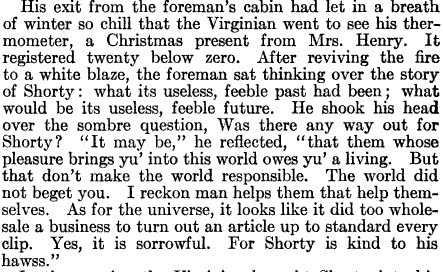
Typical of Wister's wisdom this is hard to to unravel and could be over looked. So the world is a "wholesale" project for the Creator and not every element is as good as the next. He admits that ones parents may have a responsibility to you but the world certainly does not.


"A half-great poet once had a wholly great day" Wister outlines another aspect of the Virginian's character; being kind to animals is an acknowledged attribute in many circles.


The Virginian ruminates on the life threatening embarrassment at the time of "meeting her parents."


So the Virginian talks about something that most of us in an intact civilized society will never have to be a part of; deciding on, and acting on an execution. He also makes mention of "trashy curiosity" well I guess folks will be folks, no matter what the century, and that not looking is OK too.


One of the many meaty subjects explored by Wister is this one of street justice, a huge topic that I won't dig into except to say that murdering people for steeling is a little over the top. Wister seams to be justifying the practice at the same time not agreeing with it.


"Proof I don't value my own nature enough to shield it from slander" wow, Wister can come up with the essence sometimes!

Thanks Owen, Tom