Saturday, January 3, 2015

Kenilworth by Sir Walter Scott (1821)

I'm on a S.W.Scott tear and so after Durward I decided to stick with the 1500's and get into Kenilworth.
I have to admit however that the motivation to read it came from Owen Wister and the multiple references made to Kenilworth in The Virginian.
The message Wister was trying to send is very clear; Chivalry, court manners, and how ambition and talent are rewarded. Wister and his buddy Roosevelt were trying to create the mythology of American exceptional ism and the model was based on the Chivalry Europe.

Its a story of intrigue, love, deception, hate, and ambition (to name a few.)


This little 1928 copy of Kenilworth has tiny font!
Kenilworth is an excellent book.
Scott provides a huge wealth of English language knowledge that requires a close connection with a dictionary in order to keep up with the hundreds of unused and alternative meanings. For instance, being impolite in Court might be dis-courteous. The origins of polite society are rooted in the Courts of nobility.
A great deal of Court behavior and etiquette is relayed to the reader and in it we can see how much of our Curtseys and manners were developed, derived, and refined in those courts. 

This copy has a tremendous set of notes in the back, well worth finding a copy that includes them.


Just as in Durward, Kenilworth is Historical fiction, it is a tremendous lessen in history, QE I is the period and what a period it was. I would like to get into the Elizabethan history now.

Every period longs for the one that just past and Scott's is no exception; not only did Scott long for the Chivalry of the past but the characters in his story did as well.
In the story near the culmination of the intrigue there is a performance put on for QE that depicts the entire history of the English peoples. So again Wister could only fabricate for America what England had many versions of; a past.

We get introduced to Wayland Smith (Wayland Smithers?) a very talented smith that is mostly unappreciated. He is whom I relate to.


A great passage:
When the Queen finds out that Her Doctor was refused access to her liege:
The Queen answered hastily, and without affecting to disguise her satisfaction, "By my word, I am glad he is better. But thou wert over-bold to deny the access of my Doctor Masters. Knowest thou not the Holy Writ saith, 'In the multitude of counsel there is safety'?"
"Ay, madam," said Walter; "but I have heard learned men say that the safety spoken of is for the physicians, not for the patient." 
 Well little has changed.


Monday, October 20, 2014

Quentin Durward by Sir Walter Scott (1823) Illu.

Well I can see a limited appeal for this book in today's audience. It is a little slow going but if you are a fan of the period then it is a wonderful review of the Louis XI and his world. With an internet connection nearby one can look up the dozens of references to other historic figures and events that Scott weaves into the narrative.

A nice old copy pub. 1906
And only two illustrations:
Interesting that Quentin disappears for about a quarter of the the book as the author develops the the story around Louis and Duke Charles of Burgundy.
I would say that a lot of the fiction is less intriguing than what really happened and that is why it is so interesting to look at the actual events while reading.

Scott's human insights are grand!
Very early on a paragraph caught my eye:
"The eldest and most remarkable of these men in dress and appearance, resembled the merchant or shopkeeper of the period. His jerkin, hose, and cloak were of a dark uniform colour, but worn so threadbare that the acute young Scot conceived that the wearer must be either very rich or very poor, probably the former. The fashion of the dress was close and short, a kind of garment which was not then held decorous among gentry, or even the superior class of citizens, who generally wore loose gowns which descended below the middle of the leg"
In the suburb of Detroit where I live there are some old money running around and in the very same way that the Scot conceived the shabby clothed gent could be either rich or poor we too have our share of them

In this paragraph Quentin is lectured by the Bohemian:
""Simply," replied the Zingaro, "that those who know aught of the Most Christian King, are aware that the purpose about which he is most anxious, is always that which he is least willing to declare. Let our gracious Louis send twelve embassies, and I will forfeit my neck to the gallows a year before it is due, if in eleven of them there is not something at the bottom of the ink horn more than the pen has written in the letters of credence.""
 A very period way of saying "more than meets the eye."

De Comines corrects his majesty on the merits of "moderation"
""At least I would have your Majesty be in a condition to discuss them all."
"Yet moderation, De Comines, moderation in success, is—no one knows better than you—necessary to its ultimate advantage."
"So please your Majesty, the merit of moderation is, I have observed, most apt to be extolled (praised) by the losing party. The winner holds in more esteem the prudence which calls on him not to leave an opportunity unimproved.""

Quentin's conversation with the Bohemian at his moment of death is captivating:
""Unhappy, most unhappy being! Think better! let me speed for a priest—these men will delay yet a little longer. I will bribe them to it," said Quentin. "What canst thou expect, dying in such opinions, and impenitent?"
"To be resolved into the elements," said the hardened atheist, pressing his fettered arms against his bosom; "my hope, trust, and expectation is that the mysterious frame of humanity shall melt into the general mass of nature, to be recompounded in the other forms with which she daily supplies those which daily disappear, and return under different forms—the watery particles to streams and showers, the earthy parts to enrich their mother earth, the airy portions to wanton in the breeze, and those of fire to supply the blaze of Aldebaran and his brethren.—In this faith have I lived, and I will die in it!—Hence! begone!—disturb me no farther!—I have spoken the last word that mortal ears shall listen to.""
 He is talking about dust to dust & ashes to ashes, Scott is able to calmly discuss the various views of the world and the after life with out judgment.

Thursday, August 7, 2014

J W Waterhouse by Anthony Hobson (1989)

OK not a vintage book, but a book about one of the great vintage Artists.

Hobson provides a nice chronology of the life of the great Waterhouse. His works have probably been seen by most of the civilized world even thought they don't know his name.


I became interested when he kept popping up every time I looked for images of the classics. Waterhouse unabashedly painted young women in vulnerable or tender moments, extracting these images from his extensive reading of the classics and of the great writers of his time. Now I need to pick up some Tennyson.


The book has a large (but not all) collection of his works, the website even has the locations of pieces on public view, now we make sure to see them as we travel. 


Without a doubt one of his finest works. Waterhouse was good from an early age and came from a family of artists; it always helps.


Tuesday, July 29, 2014

The Deerslayer by James Fenimore Cooper (1841) Illustrated by N. C. Wyeth

The Deerslayer; a fantastic story.
In spite of all the criticism that surrounds the Leather Stalking series The Deerslayer is a very well motivated story, it rolls along at a quick pace for the first 1/3rd and only then has small lapses of the famous tedious over descriptive paragraphs. This by no means takes away from a good story telling experience. I have only The Last of the Mohicans as my other reference to Cooper.


I have this big Illustrated copy from 1929 in perfect condition.


N. C. Wyeth is notable do to his tremendous output of paintings and interesting because his family traces back to 1645 arrival to the American continent.


Of all the illustrations in the book this one is my favorite; it is of sweet little Hetty setting out to rescue her father and Hurry. The stunning beauty of the canoe (as with all classic yacht forms) is so faithfully brought to (better than) life.

In chapter 25 The Deerslayer and Judith have a spirited discussion about the Afterlife; the compares two different but similar views of a "better place."

In chapter 26 The Deerslayer provides marriage advice to Hist; referencing "cloudy day in the Lodge" he recommends keeping the "window to your heart open" so that there will always room for sunshine to enter. Wise words indeed.

On the final page Cooper expounds on the ethereal nature of life and lives.

"From all these signs, it was probable the lake had not been visited since the occurrence of the final scene of our tale. Accident or tradition had rendered it again a spot sacred to nature, the frequent wars and the feeble population of the colonies still confining the settlements within narrow boundaries. Chingachgook and his friend left the spot with melancholy feelings. It had been the region of their First War Path, and it carried back the minds of both to scenes of tenderness, as well as to hours of triumph. They held their way towards the Mohawk in silence, however, to rush into new adventures, as stirring and as remarkable as those which had attended their opening careers on this lovely lake. At a later day they returned to the place, where the Indian found a grave.
Time and circumstances have drawn an impenetrable mystery around all else connected with the Hutters. They lived, erred, died, and are forgotten. None connected have felt sufficient interest in the disgraced and disgracing to withdraw the veil, and a century is about to erase even the recollection of their names. The history of crime is ever revolting, and it is fortunate that few love to dwell on its incidents. The sins of the family have long since been arraigned at the judgment seat of God, or are registered for the terrible settlement of the last great day.
The same fate attended Judith. When Hawkeye reached the garrison on the Mohawk he inquired anxiously after that lovely but misguided creature. None knew her—even her person was no longer remembered. Other officers had, again and again, succeeded the Warleys and Craigs and Grahams, though an old sergeant of the garrison, who had lately come from England, was enabled to tell our hero that Sir Robert Warley lived on his paternal estates, and that there was a lady of rare beauty in the Lodge who had great influence over him, though she did not bear his name. Whether this was Judith relapsed into her early failing, or some other victim of the soldier's, Hawkeye never knew, nor would it be pleasant or profitable to inquire. We live in a world of transgressions and selfishness, and no pictures that represent us otherwise can be true, though, happily, for human nature, gleamings of that pure spirit in whose likeness man has been fashioned are to be seen, relieving its deformities, and mitigating if not excusing its crimes"

 I so wished that Hawkeye would take Judith for his wife. To him however she is damaged goods. Cooper illustrates her vagaries in a single paragraph and not in detail enough to make it stick. I suppose looking at the simple lines "the gal has her vagaries" and that she has spent time in the settlements where she "has caught more than is for her good, from the settlers, and especially from the gallantifying officers" from our 21st cent view point these words mean too many things but in the 1840's may have been all one needed to say about a woman.

The essay, In Defense of Judith: A Re-Reading of Cooper's The Deerslayer as Social History provides discourse on some of the potential failings of our hero. He is intolerant of others failings but acknowledges none of his own.This is the best description of the times, issues, and realities Cooper has en devoured to illuminate for us.


Monday, June 30, 2014

The Circus of Dr. Lao by Charles G. Finney (1935)

The Circus is interesting... not sure it holds a top spot for me however it is insightful and fantastical. I will call it "Dark reality Fiction." The book as compared to the movie has no real plot line, instead it takes us thru several characters from the morning announcement in the local news through the end of the show that evening.

I found a perfect condition 2nd printing, the book was originally printed with illustrations by Boris Artzybasheff. Boris was a genius in the the graphic arts field although I feel the Circus renderings are not his best.

I have read no other book that introduced as many new words (to me) as this short story. If you ever wished the English language had a word for this or that you may find it here. Finney, a man of the world was either well educated or a trickster, he introduces so many characters from ancient mythology.
Imagine 1935 for a moment, a time distant enough from the WWI and the collapse of the vision of the greatness of Man's emergence from the dark ages, and with all the seeds of the WWII sprouting right in front of you.
Imangine too, trying to read this thing in 1935... you would have to had read it in the library, only the most well read would have known the slightest background to the mythological references. For us, we lay back in the lounge chair and look up each new and incredible reference with ease on our ISomething. It is really a short story but when you take in the "look up" time it can take a while to get through; and that's OK.

Some meaningful quotes:
   "Madame, the role of skeptic becomes you not; there are things in the world not even the experience of a whole life spent in Abalone could conceive of." I think of this when I see a beauty queen on Fox explaining how Bowe Bergdahl should have done this or could have done that; seriously, your experience in back room with the other models provides you with the life experience to comment on this situation, shame on you. (I am aware that in fact these people are making a fortune inflaming their base and not really trying to understand anything)

   I a sequence while discussing the Mermaid with another banal character described as all Americans do, by their occupation, Dr Lao explains how he would like to release her and how he feels about that release: "Oh God if I could have only seen her when I was a young man! The contemplation of her beauty might have changed my whole life, Beauty can do that can't it?
He goes on to explain how he wishes she might thank him for releasing her. As an old man I dream of how a younger woman might treat me as well.

   Regarding the Hedge Hound, Breed, breed, breed. Fill and refill the wombs of the world. Tumescence and ejaculation. Flinging out spore and seed and egg and bud. Quickening and birth. Sterility and death. That is life, I thought,... He goes on to ask the weather there is an animal that is not governed by such a cycle. Finney creates such a creature in the Hedge Hound. I for one contemplate how truly poor the process of Evolution is regarding the current pathetic status of the world after all of the "refilling" that has been done so far. In addition I have often wondered what kind of place this would be if the Sex drive weren't quite so overwhelming?

   I can't figure out how Satan Mekratrig got into this book because the only reference seems to come from a 1968 book by Robert Heinlein? Anyhow an interesting investigation could be made into this character too.

   I am convinced that it requires a second read; I do like Finney's take on the absurdity of it all.

Saturday, June 7, 2014

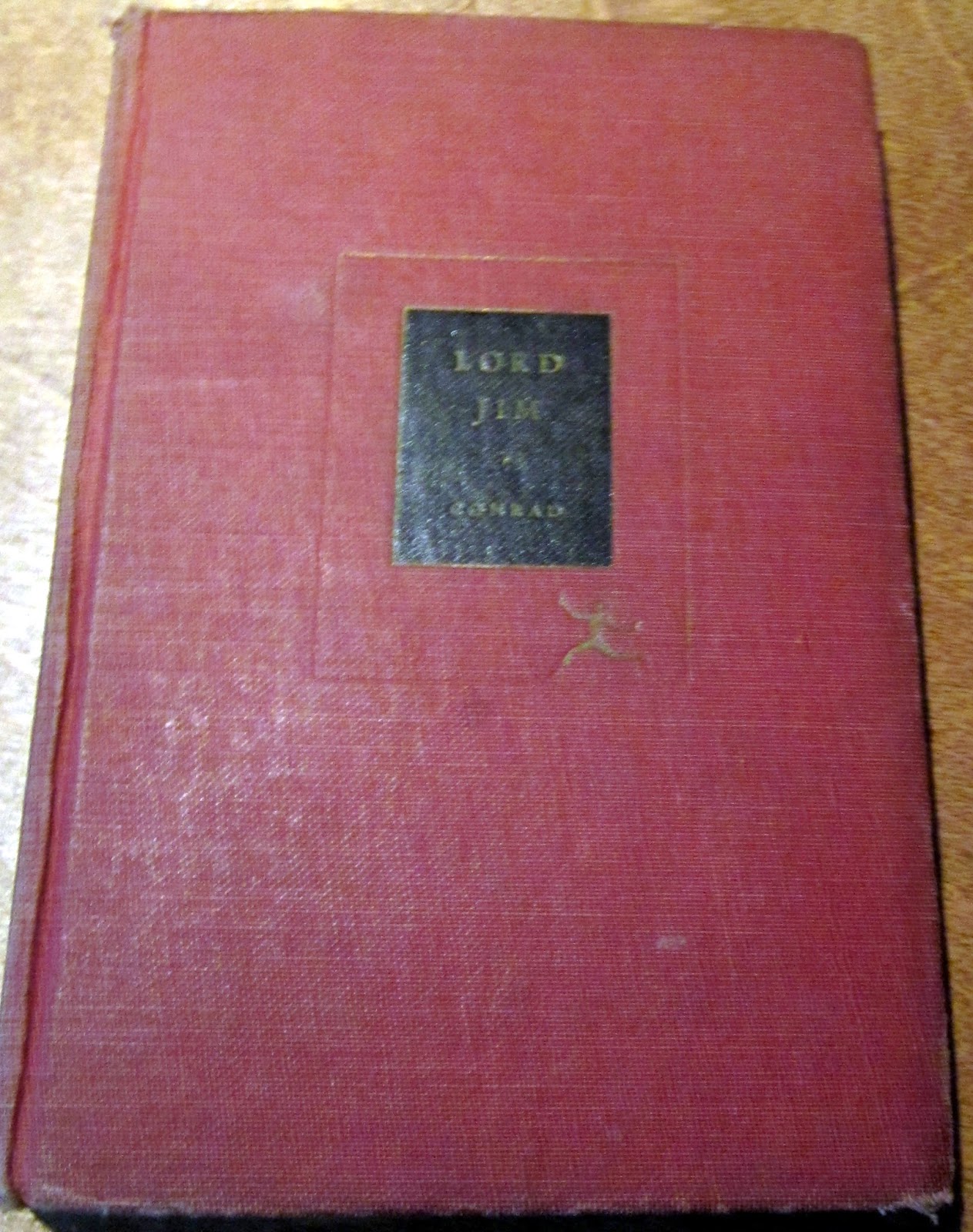
Lord Jim by Joseph Conrad (1900)

My third Conrad in the last four books I have indulged in, Lord Jim is the longest and most complicated of the three.

Once again I am struck by the amazing world that was the end of the 1800's; an incomprehensibly large globe with places and people that really were a long way away and very different from "us." I don't get the impression that Conrad ever thought that the world would get any smaller than the one he sailed thru or that he could conceive of a world as small as the one in which we live in; his stories are of people that flee from their civilized world and can actually get to a place of total and complete remoteness.

FYI, both Schomberg and to a large extent Marlow show up in this tail.


Jim becomes master of a native community not unlike Kurtz but unlike Kurtz is a good and benevolent leader and a "romantic" till the end. And Jim is not unlike Axel in "Victory" who isolates himself on a desolate island only to have outside forces intrude and destroy what he has gained.


Jim's simple and seemingly rational decision (under great peer pressure) to save himself and jump from the Patna becomes the Scarlet Letter of his life.  Having come from a part of the world where the "rule of law" exists he is held accountable for his actions on the Patna and cannot escape this branding. And so in a world that is unfathomably large poor Jim cannot escape his tormentors no matter how far he travels until he gets to the remote and dinghy island of Patusan.

Conrad posits a situation where there is no way for us (the reader) to be certain what we would have done either. Jim's particular situation was not entirely of his own making however as we see several times over he is a poor judge of character and as a result puts himself into unrecoverable states.

At an early age Jim has fantasies of heroic acts in action but he fails early on in his 1st real chance to be a hero. After the Patna he wishes to return to his old pursuit of greatness but is incapable of shaking the verdict of the court and is tormented by his inability to redeem himself, until he gets to Patusan. His redemption is fairly complete there, they do not know about the Patna and would not believe it anyway. So in fact he does achieve a complete break from his past actions by traveling to the ends of the earth, something far more difficult for us in todays world.

In his unending efforts to help (or eventually rid himself of) Jim, Marlow visits his old friend Stein. Their conversation leeds Marlow to an understanding and a wonderful bit of advise on life:
   '"I understand very well. He is romantic."
'He had diagnosed the case for me, and at first I was quite startled to find how simple it was; and indeed our conference resembled so much a medical consultation—Stein, of learned aspect, sitting in an arm-chair before his desk; I, anxious, in another, facing him, but a little to one side—that it seemed natural to ask—
'"What's good for it?"
'He lifted up a long forefinger.
'"There is only one remedy! One thing alone can us from being ourselves cure!" The finger came down on the desk with a smart rap. The case which he had made to look so simple before became if possible still simpler—and altogether hopeless. There was a pause. "Yes," said I, "strictly speaking, the question is not how to get cured, but how to live."

In this enlightening passage Conrad spells out one of the realities of the adventurous life in the late 1800's: 
    I knew very well he was of those about whom there is no inquiry; I had seen better men go out, disappear, vanish utterly, without provoking a sound of curiosity or sorrow. The spirit of the land, as becomes the ruler of great enterprises, is careless of innumerable lives. Woe to the stragglers! We exist only in so far as we hang together. He had straggled in a way; he had not hung on; but he was aware of it with an intensity that made him touching, just as a man's more intense life makes his death more touching than the death of a tree. 

Conrad's world has people whom are unfailingly true on one end and those sunken to absolute evil on the other, and the rest of us in the middle.


Tuesday, May 13, 2014

Heart of Darkness by Joseph Conrad (1899)

I have read the Heart several times but it keeps me coming back for another look. I am doing a deep dive into Conrad with Victory, The Heart, and now Lord Jim. His stories are what I would call real time blogs of what was the new thinking surrounding his time and place.

After the Out of Africa experience I decided to continue with the "last gasp" of  Imperialism theme; going from East Africa to West Africa and up the Congo.

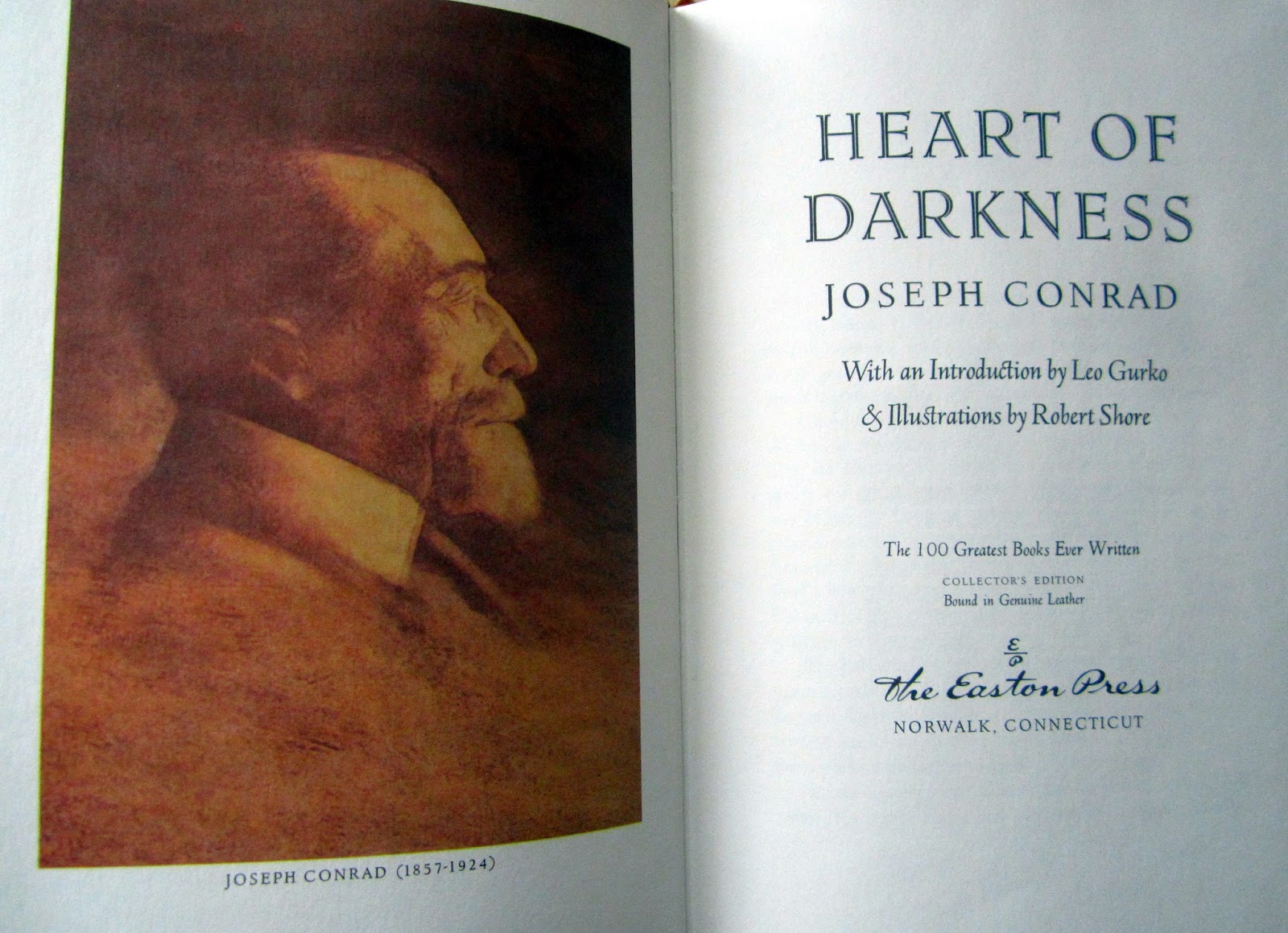
I picked up an Eaton Press Leather bound 1980 printing with illustrations by Robert Shore and introduction by Leo Gurko. Leo's intro is outstanding, a huge insight into a story that requires multiple readings to own. He helps us see "darkness and light" juxtapositions used thru-out the story, everything is described in opposing terms.


I did not know that Conrad was given to using characters over from one tale to another until I ran into Captain Marlo in Lord Jim!
Conrad was really just writing from experience; he did all this stuff!

Conrad (in the spirit of his time) seems very aware that the "savages" may be human, and the "civilized" persons may be the most savage of the lot. No other book guides us thru the world of civilization and out of it, out into a vastness, a vastness that can only be written about, a vastness that like the early American West can only be imagined. Yes I understand that a person can be lost in a ravine 100 yards from the road and never be found, I'm not talking that, I'm talking about a whole portion of the earth that was empty of human traffic.

It now occurs to me that the road to world over-population was really begun at the turn of the 1900's when the medical establishments had finally figured out the basics. So now we live in an immensely overpopulated world, a place that has no secrets, has no uncharted waters, and no where to adventure to, at least not in the way the 1900's man could. With YouTube as our guide we can see and hear the outer world, from the couch.


During the description of Kurtz that ends with "he was hollow to the core" Conrad eludes to the "whisper" of a place or situation that allows us to set free inhibitions that without Internal (or as important) External checks and balances (at least for some) allows one to take a turn down a darker road. As in drug counseling it is stated that "it starts out easy in a comfortable place" but only those that see the unfortunate potential outcome turn back. Kurtz had striped the gears, jumped the tracks, and gone over to the other side... of humanity to inhumanity; a place where under just the right circumstances almost any of might join him.

Along comes the Eldorado Exploring Expedition
 "This devoted band called itself the Eldorado Exploring Expedition, and I believe they were sworn to secrecy. Their talk, however, was the talk of sordid buccaneers: it was reckless without hardihood, greedy without audacity, and cruel without courage; there was not an atom of foresight or of serious intention in the whole batch of them,"
So yes Imperialism is institutionalized piracy; move into a virgin territory, gather the easy pickings and move on. In Conrad's "Victory"the ill fated venture was called the Tropical Belt Coal Company, but best of all is in "Lord Jim" where a couple of schemers intend on scooping up an island made up entirely of bird droppings; free for the taking!

And Conrad at his best:
"Destiny. My destiny! Droll thing life is—that mysterious arrangement of merciless logic for a futile purpose. The most you can hope from it is some knowledge of yourself—that comes too late—a crop of in-extinguishable regrets."
Argh matey, them words ring true!