Sunday, July 26, 2020

War Birds: Diary of an Unkown Aviator (1926) Illu. by Clayton Knight


All I can say is OMG; profoundly sad book. I can't recommend it unless you need some perspective on your unhappy life.

This is a story / diary of a very young man who comes to the war bright eyed and bushy tailed and who is subsequently ground to a pulp by the war machine he was born into. I say born into because we are all born into our Age  and have little choice of which war we would like to fight in.

Of course management of the flyers at that time was an all new thing, but the stress and fatigue of flying was (and is) so great that a little effort to limit there service may have been in order.

The concept of sending men into the air in these death traps was crazy enough; there was as much a chance of the plane malfunctioning or the flyer making a single mistake as there was in being shot down.

So this young man goes into training with the bravado and impatience of any 20 yo.
He parties with his mates, they find girls, they make friends, they loose friends.

They are involved in a what amounts to "field trials" for these aircraft. Maybe a third of them wash out or are killed during training.

They are human test subjects in a ridiculously fast paced series of experiments; that is "lets see if this will fly."


The War forced both sides to confront the need for Air Power. The Wright brothers had just flown their 1st flight 12 years before WWI. These engineers were masters, HOWEVER, these things were not ready for what they were used for. So the pilots died.

The shear insanity of what was attempted with this new for of weapon illustrates the lengths that humans will go.
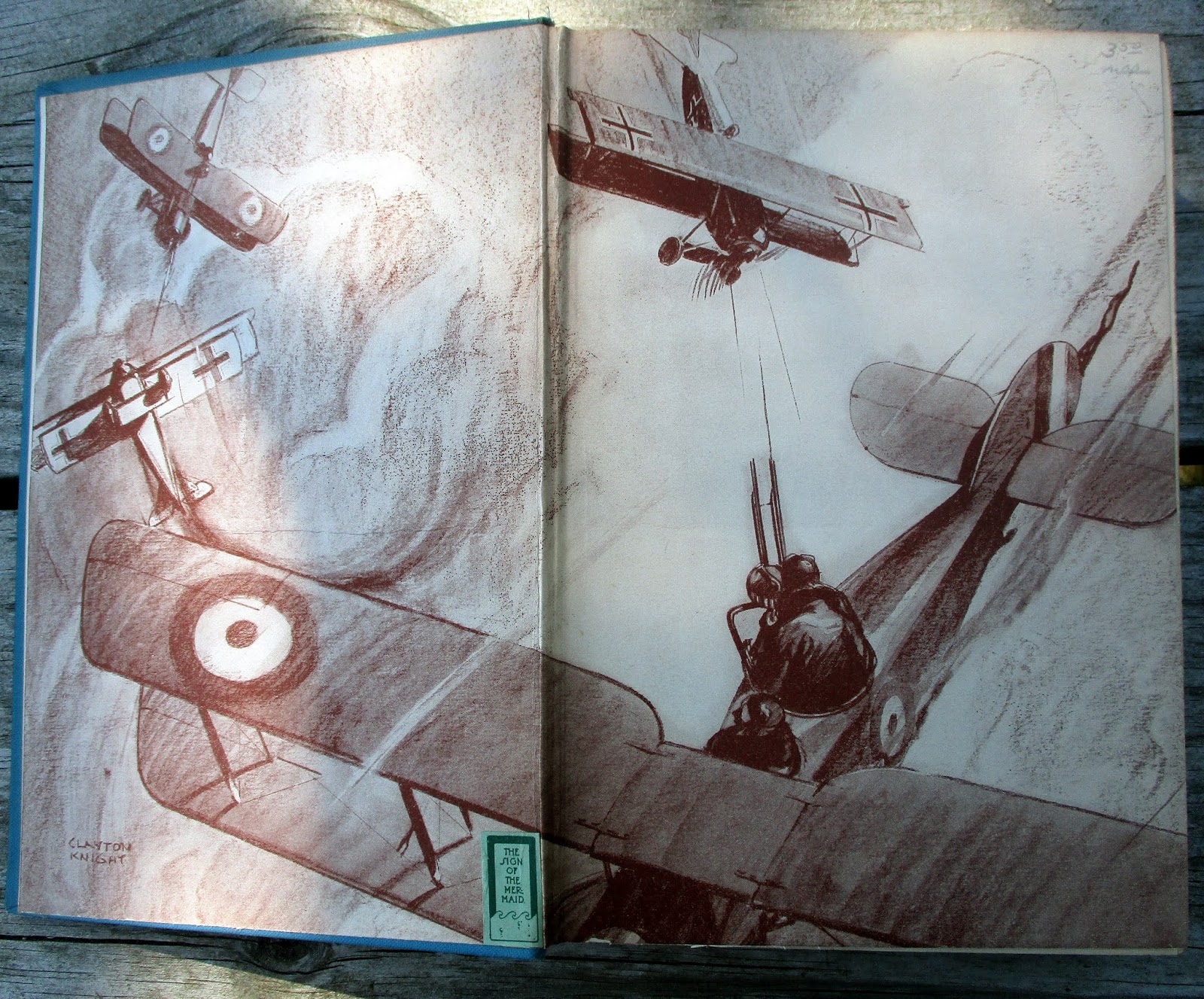


The truthfulness of the entries can be verified online as never before.


The 1st edition has reprints of these wood cuts that are stark and until you get into it they seem harsh.


If you had an interest in these old flying machines as I did in my youth than this is a deep insight.
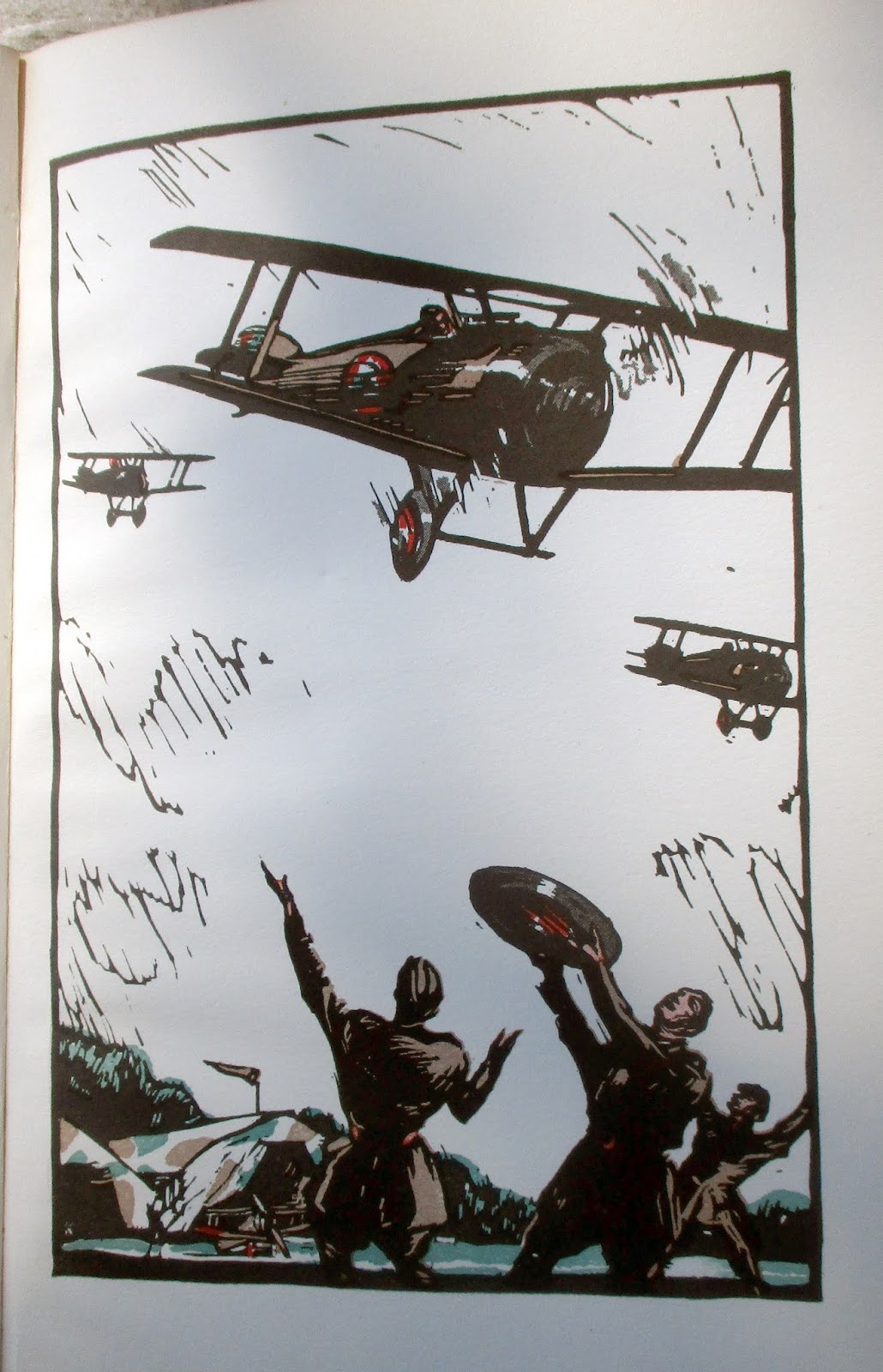


The nonchalant manner in which the author denotes another death even leaves the reader desensitized. Every other diary entry begins or ends with a one line statement of a death.


This young mans decent is horrific to watch unfold. As he descends he is continually concerned with his being perceived as not a coward. He clearly can see the Cowardice when it appears in others and has little empathy.

This however I think leads to his downfall.

As everyone around him dies he becomes fearless and appears to lose his vision of a future. loosing ones vision of a future I think is a hallmark of reckless behavior. Reckless behavior in a WWI flyer would have been a straight line to the end.


Friday, July 17, 2020

Omoo by Herman Melville (1847) Illu. by Mead Schaeffer

Loved this book, recently learned that it was 2nd in a travel trilogy that M created from his travels.

Once you get the hang of Melville writing you can settle in for the story punctuated by the didactic learning experience.

Its a sort of stop start thing that initially was annoying but now I have come to expect it.

Melville's disdain for the havoc wreaked upon the islands from the introduction of Western Civi is amazing. he would be at home today with the questioning of who the good guys are as any of the modern speakers of today.

His ultra dry humor needs to be appreciated...

"This was the place where we expected to obtain the men; so a boat was at once got in readiness to go ashore. Now it was necessary to provide a picked crew—men the least likely to abscond. After considerable deliberation on the part of the captain and mate, four of the seamen were pitched upon as the most trustworthy; or rather they were selected from a choice assortment of suspicious characters as being of an inferior order of rascality."

His opinion of the poorly educated seamen...

"Indeed, it is almost incredible, the light in which many sailors regard these naked heathens. They hardly consider them human. But it is a curious fact, that the more ignorant and degraded men are, the more contemptuously they look upon those whom they deem their inferiors." 

 His take on the few who stayed in the Islands...

"And for the most part, it is just this sort of men—so many of whom are found among sailors—uncared for by a single soul, without ties, reckless, and impatient of the restraints of civilization, who are occasionally found quite at home upon the savage islands of the Pacific. And, glancing at their hard lot in their own country, what marvel at their choice"


Sunday, June 21, 2020

The Decameron by Boccaccio (1620) Translation

The Irony was that I started reading this about a week before lock-down?

It's a tough read; the old language is very interesting though, the alternative spellings are awesome.

The Decameron is very little more or less than the Canterbury Tales.

The mere number of them (a decameron of them) is daunting, the slow nature of the reading makes it a little tedious.

They wanted for little in the middle of a pandemic. Basically the ten characters escape from Florence during the Plague and being obviously wealthy have a grand old time telling tales, dancing and singing.

Having been to Florence and the surrounding areas it is really nice to follow along, the stories reference many towns and villages in Italy.

I would say that maybe less than 10% of the translation is about the character and of course that would have been a better story.

One amazing thing is how many stories dealt with the improprieties of the Clergy; many of these guys and girls were held in very low regard some 700 years ago!


Nice little renderings scattered throughout.

No print date I suspect 60's or 70's


Sunday, February 16, 2020

The Pioneers by J F Cooper (1823)

I'm not sure how this story led to 5 subsequent writings?

The Pioneers starts out very slow and stays that way for a long time

J F was trying to warn against or at least contemplate the intensity of human activity in the New World.

He is also illustrating the clash of class as urban life intercedes onto rural life.

The series is out of order in that the 1st book printed t(his one) is telling the story of the aged and failing Natty and how civilization intrudes on his idyllic world

We have slaves, rich men, wilderness men, and the daughters of these men round out the characters list too. And of course at the end (as with all writings of this period) our young couple get the riches

The wealthy are doing what they always do; trying to make a buck by buying low and selling high.

The natural unavoidable instinct of the rich to look into the wilderness, buy it and strip it into wealth.

The American continent has provided this never ending source of easy money up until about the 1970s when the expansion ended.

I really liked all of the other books in the series, this one is not up the the exciting writing standards of the others


Sunday, September 1, 2019

The Oregon Trail by Francis Parkman (1849) Illus. Maynard Dixon


Outstanding book, great real-life encounters with basically untouched American Indians of the plains.

The only complaint is the 1/3 of the book devoted to the easy slaughter of Buffalo. The Buffalo are indeed stupid unwitting creatures and as such were easy and tempting game for those that lived in that short period of time; roughly from 1845 to 1870, the 25 years of this historic migration.

 
I have a nice copy New York: The Heritage Press, 1943.


Scattered throughout are the monochromatic renderings
Several one page full color images and one expansive two pager!

I have never read a more direct unfiltered view of the plight of the American Indian. Yes of course Parkman brought his prejudices to it. This particular book has an introduction by Mason Wade. Wade pull no punches in characterizing Parkman as an Elite snob; this is refreshing to get an honest look at the man and his era.
It seems as though (just like the Scotts) the Indians were indeed their own worst enemies; incapable of coming together they were ultimately easy to divide and concur.


(by the way I have taken to reading the Introduction to my books after finishing the book since they always assume a knowledge of the book in there writing)


The best line in the book comes from Shakespeare: To "Daff the World Aside and bid it Pass" 
A lesson we are learning all to well in these times!


Monday, July 29, 2019

Wanderer of the Wasteland by Zane Grey (1923)

Fantastic! I loved this telling of love, life, death, hatred, family, friends, and foes.

Grey ruminates thru the character of Adam upon what it means too be a man,  to be a woman, and how some might have little of each in them. (horror of horror)

The book takes on its title at the scene of the cover where upon Adam is induced by his own impulsive actions to take refuge in the desert.

I had recently finished Lin McLean; can't find anything good to say about that. So I needed a good Grey Fix

Not sure why I picked the Wanderer for my next read but am glad I did, this story sinks deep into the the mind of man and woman. Zane was know for his fondness for women, and this flavors all his great stories.

A story of an impulsive young man and his redemption thru honest and selfless deeds.

The insatiable allure of each sex for the other pervades Grey's world and this story, it is comforting to know that the flirting and allure of the "other" is universal.

I also love learning horsemanship and other survival techniques from years gone by.
Don't forget the sweeping descriptions of the Old Southwest he is great with setting the stage.

Never having thought much about Death Valley and what it meant to the explorer generations this book opens a window onto that hellacious place.


The movie came out the next year.


Saturday, June 15, 2019

Jane Eyre by Charlotte Bronte (1847)

Finally got to Jane Eyre, it was not the greatness I had hoped for.

The 1st half is slow, the second half moves better but the plot twists are annoying.

It is a segmented book as it covers Jane's early life I never felt close to any of the characters. 

She as the perennial Care Giver is supported at every step concluding with the love of her life becoming totally dependent on her.

Her time with her cousins seems most real and her zealot cousin was interesting.