Wednesday, July 3, 2013

The Virginian by Owen Wister (1902) illu.

When I asked my new friend and shoe making associate Lisa Sorrell "what do you read to get the West" she quickly came up with The Virginian, originally from Missouri she knows what Cowboys are all about. I was taking an abbreviated boot making workshop with her in OK. a world apart from MI. and I always like to read from the area of the world that I'm in. 

So I searched the net for what was out there, I am only interested in older copies of these classics and to my surprise the original printings were illustrated. This is great but led me to a decision regarding what condition and price I was going to go for. By waiting and looking I ended up with a very nice 1st year (1902) 14th printing.

The illustrations are muted, I think this is not from age but from process, but they are of course nice to have. One click in Photo Shop adds the chiaroscuro necessary for making the renderings more appealing.


After rescuing the maiden from a faltering wagon the Virginian "straightens out" the coach driver after which the driver attends to his business properly for the remainder of the trip to Bear Creek. In this, their 1st encounter, the stage is set, for the romance part of the story.

The Virginian IS the type of book for me; it contains life lessons and views on life written so clearly in  many instances that they could and should be chiseled in stone. I wish I had read this as a young man; having lost my father at the age of 16, I was free to run wild without anyone to bounce ideas and problems off of.

It may be as simple as "your reputation is you, and you are your reputations keeper." I learned this early on at work and have done my best to maintain my work reputation pretty well over more than 30 years in the same field. The Virginian is both an outstanding story of Manhood and of Romance; it teaches that if both half's of the symbiotic whole are willing to play their parts as designed by the creator then the relationship is a healthy one.

The end of the book celebrates Love and Nature, the book was dedicated to T.R. and is a direct offspring of the world that these men saw as something to preserve; the Wild West.


Just for fun I often look up the owners name inside:

Turns out Elizabeth was from old Virginia and would have been 31 at the time of printing.

Also, I was listening to Chris Isaak's "Wicked Game" it fit perfectly with the tone of the book.

I'll now got through the most poignant (for me) passages, there are many more.


Early on a lesson is observed by the narrator regarding the Power of words and the "who, how, and where" that effects the outcome of those words.


I love it when an author lists the notable reads from his day; back then this was the only way to learn other viewpoints. And Scott's Kenilworth gets a lot of free plugs, so I will have to visit it on Owen's recommendation.

This one is a little harder to divine but the concept of some perfectly good offspring not getting a chance to flourish becomes a more contemplative subject as we get older.

After Molly states clearly that we are all born equal, the Virginian illustrates that our equality diverges rapidly the day after we are born.

So here it is, one of the most clear descriptions of the rational behind the creation of the American states. Referred to as "the game" the game of life; you are born, you figure it out the best you can... or you don't. lol


And here it is for those of us who don't need a religion to know there is a God. What an incredible  lighthearted stab at the Righteous.


So the concept of restraining your anger is for some of us something to work on, we need ideas like this one to help rationalize how and why a temper can be controlled.
In addition our Southerner raps up his take on salvation i.e. Heaven and Hell.


In this instance Judge Henry speaks wisdom about some clergy that may not be able to discern a follower from a good person.


Here the Virginian laments the lack of spirit in his siblings. How often we meet those who are stuck in one time period, never to explore.

Typical of Wister's wisdom this is hard to to unravel and could be over looked. So the world is a "wholesale" project for the Creator and not every element is as good as the next. He admits that ones parents may have a responsibility to you but the world certainly does not.
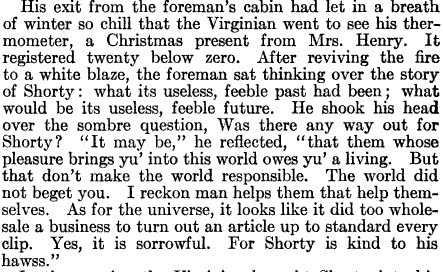


"A half-great poet once had a wholly great day" Wister outlines another aspect of the Virginian's character; being kind to animals is an acknowledged attribute in many circles.


The Virginian ruminates on the life threatening embarrassment at the time of "meeting her parents."


So the Virginian talks about something that most of us in an intact civilized society will never have to be a part of; deciding on, and acting on an execution. He also makes mention of "trashy curiosity" well I guess folks will be folks, no matter what the century, and that not looking is OK too.


One of the many meaty subjects explored by Wister is this one of street justice, a huge topic that I won't dig into except to say that murdering people for steeling is a little over the top. Wister seams to be justifying the practice at the same time not agreeing with it.


"Proof I don't value my own nature enough to shield it from slander" wow, Wister can come up with the essence sometimes!

Thanks Owen, Tom

Friday, June 14, 2013

Treasure Island by Robert Louis Stevenson (1883) illu.

Treasure Island is great. Especially if you have spent time sailing as I have, the story is much more close to home with much of the language be'in of a sea fair'in nature.

The copy I have is from a friend and was purchased for his father as a gift when published in 1924.


As Jim grows up quickly during the term of the story he learns that good and bad men come from both sides of the tracks. But as you might expect most of the good guys around sailing are from the better class.


It's too bad that the Captains role was cut short in the story; Stevenson inexplicably cuts off his leadership and wisdom too soon for me.


The concept of allegiance is explored, with Jim falling in and out of favor from one side to another, this is a source of interest and suspense throughout the book.


The story moves along nicely and Stevenson's writing is easy to get used to, very comfortable, aside from the sailing lingo.


Monday, May 27, 2013

Huckelberry Finn by Mark Twain (1885) Illu.

An awesome page turner... for the 1st 2/3s. The moment Tom Sawyer shows up the book spirals out of control. I have not read Tow Sayer and its not on my list if it is anything like the Huck Finn version of Tom.


This rendering of Huck fishing for dinner is so alluring its hard to look at; a level of serenity that can only be found in childhood (or a book.)

The entire thing is in "Southern Speak" and once you get used to it, its fun. I don't know much about Clemens but he had influences from both north and south, he did however grow up, work on, and live on the Great Mississippi.


The King an the duke are such rascals, thieving, cheating, bums. They are the another example of Huck's "follower" nature; he followed his father, he followed Tom, as well as these two bums. Huck usually took the lazy way out and couldn't see, was blind too, or lacked the proper leadership, to value education; that education that his aunt offered.

I suppose it really is a child's dream book serving the purpose of providing an escape unlike no one can have anymore.

So Huck goes along learning life lessons or not, but often takes the time to reflect; its great. He regularly finds himself in unwinable situations... "damned if you do or damned if you don't." Constantly reviewing his moral compass he was doing better and better only to backslide upon Tom's arrival. I was really rooting for his overall recovery from the dark side but ultimately he freely expresses that he is just a bad person and so there is no turning back.


The thing with Tom and his ridiculous schemes is that Huck could have said "NO" or "your an idiot" but instead goes along as if he had no choice. Twain never gives a reason for Huck's lack of spine other than his apparent low self esteem.

I can't resist thinking about (and living through) the wonderful world BC, to not know anything about relatives and friends once they are out of sight. It seems like it would be so stressful and yet we speak of this very little, now of course we complain of knowing too much.


The Fall of the House of Dixie by Bruce Levine (2013)

Continuing on with but not ending at Uncle Tom's Cabin I heard about this and decided to go for it.Yes, America's skeleton in the closet, slavery.

The GWtW version of the south before and after the war touches so little on slavery and UTC is focused on conditions and consequences. Also I just finished Huckleberry Finn where Clemens portrays a world just before the the war.


Levine's outline takes us from the early in the 1800's to post war. Here in the North the subject is usually dismissed as a states wrights issue, so I suppose, we don't have to discuss the details or the controversies.

The 100 or so year feudal system that the south had developed is interesting in that it mimicked what was common in Europe but was fast crumbling over there. I don't think that a family with a couple of generations of wealth behind it compares however to a family with a couple of centuries of wealth. In other words these people may have been "much closer to the earth" than say a Downtown Abbey sort of family.

The South's aristocratic hierarchy or cast system benefited the few but made all part of the agreement, so by having more than one class one could always feel better off that someone else. But the wealthy discovered, their wealth did not protect them from destruction no matter how loud they shouted. I would like to hear the story of the people who left before the war (if any) with their wealth intact, now that would have shown intelligence.

The subject of "the slaves didn't mind being slaves" is off the table, of course they did. Were they better off? well that's another story because they were so unprepared for freedom. After the war the retribution heaped upon them was shameful. Maybe the concept of a slow transition to freedom was just too impossible but slow transitions are always easier to accept than short ones. The South hastened the end of slavery by decades in their ill thought out zeel to maintain it.

As far as it being a rich man's war well it certainly was. The poor owned no slaves but were easily outraged with jingoistic rhetoric from there leadership.

Levine Illustrates the numerous ways that slavery and feudal aristocracy were coveted by the exceptionally wealthy with 100's of quotes from letters and news articles of the time.

If the reader is a battle historian this book would fill in many of the whys and hows of the some of the inexplicable self destructive moves made by the Southern leadership.

Monday, February 11, 2013

Ivanhoe by Sir Walter Scott (1820) Illu.

I loved it, it's amazing to think of what Scott created in writing methodology, the time overlapping is well done. Occasionally you wonder what happened to a character but eventually all loose ends are tied up. I agree though regarding Aethelstane's return from the dead was a little much and I think unnecessary to get him out of a fix the way Shakespeare used to bring them back to life. It is satisfying to have Aethelstane let the young people have each other.


The history lesson is great and leaves one thinking and looking for the actuality of the Plantagenet line. The story explains that the Normans from France were actively upgrading the culture that was predominant on the British Isles beforehand.


Ivanhoe has aligned himself with King Richard the Lion Hearted. Ironically Ivanhoe speaks possibly the fewest words of any of any character in the entire story; he is known far and wide for his actions.
The descriptions of Coningsburgh Castle are so enticing and unlike the 19th century reader I just pick up my IPhone and see it for my self, bridging both time and space from the comfort of my reading chair.


The amount of Jew bashing was a real an eye-opener; I think in terms of WWII but this hate thing has been going on forever! A substantial part of the book is devoted to Isaac and his daughter they are good characters too. Scott is only reporting on how things may have been for the Jews in the 1100's, during his time in England laws were changing with respect to discrimination.


With in-depth descriptions of the "Lists" and "tilting" all the while weaving the story between characters makes this a must read for those interested in the origins and functioning of chivalry.


I never understood how the Isles (being so small) could be so steadfast against change in one area and under constant change in another; the Scots and the Irish have maintained their uninterrupted blood lines far better than the southerners.


As I am buying exclusively Illustrated versions of the classics; I spent a lot of time on Ebay looking for the "best" illustrated version I could find; for me I think this is it. I love the Schoonover illustrations; they really help set the tone and "paint" the picture. They are old fashioned renderings, of an old fashioned story, about an old fashioned time.


Saturday, January 26, 2013

Candide by Voltaire (1759) Illu. Rockwell Kent

Completely unaware of what I was getting into I picked up a vintage 1929 copy of Candide with of course cool renderings through-out. Having not followed a lot of satire in my recent readings I was unprepared for Voltaire's brutal truism's about life; it is very good, humorous in a macabre way.  


Unfortunately as with all of the publications like this one the cover is badly faded, cheap dye I guess.
But its the illustrations by Kent that I am so pleased with, how ever disturbing some of them are, and there are plenty, every page has something on it.


Death and destruction, betrayal and cruelty, what appears to be one thing is something else entirely.


Here is Candide leaving the only place that where he was happy with the treasures that ultimately carry him along in relative comfort but due to his lack of shrewdness and the unrelenting evil imposed on him by others he is regularly relieved of its burden.

Each chapter is it's own little episode that leads with the previous and ends heading towards the next.

I don't know why Voltaire wrote this book; it has a peculiar feel about it. I guess he may have been at the the forefront of the period of questioning religion and believing in science. By the time we get to Madame Bovary the questioning is in full swing!