What an outstanding book.
I didn't know what to expect but it is such a pleasing story. A children's book yes, it has that feel but it covers many of life's major problems much of them with fine Yorkshire honesty.
This is an excellent book for children to read and discuss; so many spot-on life lessons are laid out clearly and plainly.
Found this when I ran out of reading material up north.
It has a beautiful cover made of some faux leather like material.
The characters are great, and the 1st half is with out flaw, the second half brings in the power of positive thinking; a new concept in the early 1900s and it gets just a little thick at times.
Ben gives a little insight into his opinion on authority:
“Th’ best thing about lecturin’,” said Ben, “is that a chap can
get up an’ say aught he pleases an’ no other chap can answer
him back. I wouldn’t be agen’ lecturin’ a bit mysel’ sometimes.”
Mrs Sowerby steels the show at times with her wisdom.
“Two worst things as can happen to a child is never to have his own way - or always to have it.”
Ben:
“The robin flew from his swinging spray of ivy on to the top of the wall
and he opened his beak and sang a loud, lovely trill, merely to show
off. Nothing in the world is quite as adorably lovely as a robin when he
shows off - and they are nearly always doing it.”
I have noticed this year especially that the Robins are some of the most friendly and least fearful of the birds in the neighborhood.
Martha:
“Listen to th' wind wutherin' round the house," she said. "You could bare stand up on the moor if you was out on it tonight."
Mary did not know what "wutherin'" meant until she listened, and then she understood.
Martha may be the most fun to read of all.
During the winter of 2009 I started back into reading on a daily basis. I am reading the classics and some of the background history that illuminates them. My favorite period is the early 1800's
Thursday, July 28, 2016
Thursday, July 14, 2016
Overland to Cariboo: an eventful journey of Canadian pioneers in 1862 By Margaret McNaughton (1896)
Found this old gem recently, payed $2 for it, can't find any better on the net for under a $100.
It is an "account" of what happened in second hand by the wife of one of the adventurers.
An astonishing account of perseverance, blind stupidity, and luck (by most) in trying to get to the Gold rush site in Cariboo.Once again greed is a substantial motivator. The Great Expectations of many are met in spades but only after substantial hardships.
And as in Great Expectations these men have forged life long alliances with their fellow travelers that served them well through out their remaining years.
The book has many pictures (some useless) but all intended to capture the moment which they do.
Really nice condition copy.
The stout looking Margarete.
Let's go!
Are you kidding me? Wooden wheels NO metal parts, what a nightmare.
The Canadian Indians of the day were much friendlier than our Western Indians; Canadian Eh?
Without their help at critical points some of the travelers would not have made it.
A 50hr trip by car!
The Panama Canal was under construction at the time of the writing but the only other way to get there in 1862 was around the Horn.
I didn't count how many times "the boat overturned and they lost every thing" came up but it was a lot.
The book ends with a one page Bio for some of the key players and illustrates how hardship can make the man. And how hardship endured together can forge a future
Kudos to all the Canadians and the Immigrants that accomplished this dream.
It is an "account" of what happened in second hand by the wife of one of the adventurers.
An astonishing account of perseverance, blind stupidity, and luck (by most) in trying to get to the Gold rush site in Cariboo.Once again greed is a substantial motivator. The Great Expectations of many are met in spades but only after substantial hardships.
And as in Great Expectations these men have forged life long alliances with their fellow travelers that served them well through out their remaining years.
The book has many pictures (some useless) but all intended to capture the moment which they do.
Really nice condition copy.
The stout looking Margarete.
Let's go!
Are you kidding me? Wooden wheels NO metal parts, what a nightmare.
The Canadian Indians of the day were much friendlier than our Western Indians; Canadian Eh?
Without their help at critical points some of the travelers would not have made it.
A 50hr trip by car!
The Panama Canal was under construction at the time of the writing but the only other way to get there in 1862 was around the Horn.
I didn't count how many times "the boat overturned and they lost every thing" came up but it was a lot.
The book ends with a one page Bio for some of the key players and illustrates how hardship can make the man. And how hardship endured together can forge a future
Kudos to all the Canadians and the Immigrants that accomplished this dream.
Great Expectations by Charles Dickens (1861)
I did not like it as much as David Copperfield however it is very good. As relevant today as when written.
As with all Dickens it has the Good, the Bad, the Ugly, the Evil, the Kind, the Smart, the Dumb, the Intelligent, and the Common folks depicted in very insightful ways. Oh, and redemption too.
I would say that the 1st half sort of plods along but it takes all that to set the stage for the second half.
The 2nd half becomes a whirl wind of action, intrigue and adventure.
Got tired of waiting to find a better one at the estate sales so I picked this one up.
No date, maybe early 1900's
Pretty good condition.
Don't know how they served themselves or the readers by leaving out the details but this is all you get when it comes in a set.
The only illustration was a very poor choice but, they often are.
Amazing contrasts between city and country characters.
The city characters all have a forced duplicity in that they are play acting when at work and more real to their nature when at home. Wemmick is so likable at home and I wish he were a friend of mine; able to switch from business to personal and keep the two in their own compartments. I guess I have known many who can and cannot make this transition; if required it is the better way to go, duplicity that is.
One of the searing quotes:
"All other swindlers on earth are nothing to the self-swindlers" never heard it put so sharply.
Pip to me becomes a good "every-man" in-spite of his (and others for him) Great Expectations. Oh to recall my own Great Expectations and to now confront the reality of a life where much good has been achieved, many missteps taken and my Great Expectations won't be achieved.
The young many about town, having fun spending all his money, getting in debt and finding out he is a fraud. So as soon as he discovers his benefactor's real identity we as readers are forced to decide what we would do; keep riding the gravy train comes to mind. Pip has a young man's idealism and decides otherwise.
Although he never "goes back to the farm" he admits several times he may have been happier staying there.
Magwitch is one character that is a product of his upbringing (this of course could never happen today) but strives to good for his own legacy. He however is chained to his inescapable past doings, as are we all.
The concept of a benefactor is the only device that on the surface seems rare however social privilege has in fact a similar effect. And too the benefits of making and retaining friends through out the course of life is a critical take away and should be heeded well by the young reader. Loosing all your formative years friends is a mistake. FYI by formative years I mean your late teens and twenties, friends after that (in the words of my stepfather) are most likely just acquaintances.
Several times we wish Handel would stop over thinking things and consider the better option or just take it all in instead of coming to things with a preconceived notion.
The book has many lessons for those of you living a dream. I think the hardest lesson to see is how each life event is going to force a future upon you, and how to shape that event outcome for the best; the forest for the trees issue. The old adage: life is 10% what happens to you and 90% how you react to it, could be calculated for each of the characters in the novel, it would be fun to place each of them on an X Y chart.
As with all Dickens it has the Good, the Bad, the Ugly, the Evil, the Kind, the Smart, the Dumb, the Intelligent, and the Common folks depicted in very insightful ways. Oh, and redemption too.
I would say that the 1st half sort of plods along but it takes all that to set the stage for the second half.
The 2nd half becomes a whirl wind of action, intrigue and adventure.
Got tired of waiting to find a better one at the estate sales so I picked this one up.
No date, maybe early 1900's
Pretty good condition.
Don't know how they served themselves or the readers by leaving out the details but this is all you get when it comes in a set.
The only illustration was a very poor choice but, they often are.
Amazing contrasts between city and country characters.
The city characters all have a forced duplicity in that they are play acting when at work and more real to their nature when at home. Wemmick is so likable at home and I wish he were a friend of mine; able to switch from business to personal and keep the two in their own compartments. I guess I have known many who can and cannot make this transition; if required it is the better way to go, duplicity that is.
One of the searing quotes:
"All other swindlers on earth are nothing to the self-swindlers" never heard it put so sharply.
Pip to me becomes a good "every-man" in-spite of his (and others for him) Great Expectations. Oh to recall my own Great Expectations and to now confront the reality of a life where much good has been achieved, many missteps taken and my Great Expectations won't be achieved.
The young many about town, having fun spending all his money, getting in debt and finding out he is a fraud. So as soon as he discovers his benefactor's real identity we as readers are forced to decide what we would do; keep riding the gravy train comes to mind. Pip has a young man's idealism and decides otherwise.
Although he never "goes back to the farm" he admits several times he may have been happier staying there.
Magwitch is one character that is a product of his upbringing (this of course could never happen today) but strives to good for his own legacy. He however is chained to his inescapable past doings, as are we all.
The concept of a benefactor is the only device that on the surface seems rare however social privilege has in fact a similar effect. And too the benefits of making and retaining friends through out the course of life is a critical take away and should be heeded well by the young reader. Loosing all your formative years friends is a mistake. FYI by formative years I mean your late teens and twenties, friends after that (in the words of my stepfather) are most likely just acquaintances.
Several times we wish Handel would stop over thinking things and consider the better option or just take it all in instead of coming to things with a preconceived notion.
The book has many lessons for those of you living a dream. I think the hardest lesson to see is how each life event is going to force a future upon you, and how to shape that event outcome for the best; the forest for the trees issue. The old adage: life is 10% what happens to you and 90% how you react to it, could be calculated for each of the characters in the novel, it would be fun to place each of them on an X Y chart.
Tuesday, May 31, 2016
Crittenden: A Kentucky Story of Love and War by John Fox Jr. (1910)
Without question, the most racially charged jingoistic book I have ever read. Fox really bought the American Exceptionalism thing and was peddling it with every bone in his body. In fact every aspect of this writing is over the top. The love of country, the purity of the American Soldier, the depth of love, the height of compassion, etc. Like The Long Rifle by White it seems to have been written in a style from about a century earlier. White, however, does not devolve into the preachy.
Its an OK quick read and fits well within the "where does America come from" theme that I have been on but is patently out of fashion in its portrayal of all things. It had to offensive, even for its time?
Fox was a Rough Rider in the Spanish American war, was a correspondent, and was from Kentucky so this is him speaking. Clearly proud of his service in the war he takes the whole thing a little too far at times. The war scenes are, however, well rendered and he holds no punches, making several references to the amount and severity of the various illness available to one on campaign in the tropics. He also portrays battlefield horror in fairness and in detail (I have no experience) and so was likely changed by it.
Military service as pure and redemptive; in modern parlance: as a team building exercise, that leaves one whole and completely in love with ones fellow man and his Country. There are however lesser beings who should be cared for and snickered at for they are simple.
He speaks of this war as a turning point (which lets face it most people don't even remember it ever happened) in which America becomes a world power. That is interesting because most of us think of WWII as having that effect. I guess the last war we fight is a new turning point. And any war I fought in was a big deal; it has to be...
Fox presents this war as the first unifying event after the Civil War and goes on at great length about how the North and South came together to form this irresistible force.
Highly classicist he outlines the "blood line" nepotism that permeated every aspect of Southern life. These guys speak about the every-man but revere the blue blood.
A nice 1910 printing
It has the very raged edges by design on very thick paper which become more endearing the more you fiddle with them.
The Coon rendering is magnificent.
Its an OK quick read and fits well within the "where does America come from" theme that I have been on but is patently out of fashion in its portrayal of all things. It had to offensive, even for its time?
Fox was a Rough Rider in the Spanish American war, was a correspondent, and was from Kentucky so this is him speaking. Clearly proud of his service in the war he takes the whole thing a little too far at times. The war scenes are, however, well rendered and he holds no punches, making several references to the amount and severity of the various illness available to one on campaign in the tropics. He also portrays battlefield horror in fairness and in detail (I have no experience) and so was likely changed by it.
Military service as pure and redemptive; in modern parlance: as a team building exercise, that leaves one whole and completely in love with ones fellow man and his Country. There are however lesser beings who should be cared for and snickered at for they are simple.
He speaks of this war as a turning point (which lets face it most people don't even remember it ever happened) in which America becomes a world power. That is interesting because most of us think of WWII as having that effect. I guess the last war we fight is a new turning point. And any war I fought in was a big deal; it has to be...
Fox presents this war as the first unifying event after the Civil War and goes on at great length about how the North and South came together to form this irresistible force.
Highly classicist he outlines the "blood line" nepotism that permeated every aspect of Southern life. These guys speak about the every-man but revere the blue blood.
A nice 1910 printing
It has the very raged edges by design on very thick paper which become more endearing the more you fiddle with them.
The Coon rendering is magnificent.
Tuesday, May 24, 2016
The Long Rifle by Stewart Edward White (1932)
Excellent; I'm getting a picture of the tide that swept over the continent, White's book is a wonderful "101" regarding the American expansion west into the Rockies. This is a story about the Mountain man; the Original Mountain Men of the Rockies. I am very happy to have found this and hope to move on to other White stories. It literally takes off from the D. Boone Bio. I finished prior to my workshop.
Like our hero Andy, the story leaves me a little sad.
So the Brits had the Northwest, the Mexicans had the Southwest, and the Americans had the middle, we all know how it turned out.
I guess if it wasn't land that was "free for the taking" it was beaver. And freely they took it, although not without hardship, but still free for the taking. We venerate these men for public and private reasons; what they did was hard and when they survived year after year doing it we are amazed and can only hope or wish we had that kind of fortitude.
So although this was written in the 1930s and I am devoted to the 1830s writers White seems to be from the earlier time. I have lost much interest in the "modern" writers and their sardonic views.
I found a 1st Edition 3rd printing in Xenia Oh. at the stunning Blue Jacket Bookstore on my way to my Flintlock making workshop.
The inside covers outline some of their stops along the way.
White spent time in the wilderness of the early 1900's and seems to know his stuff. He provides many details about life in the mountains. He researched hundreds of early documents to achieve the level of historical accuracy he needed for this Historical Fiction.
A little of White's wisdom that I like:
"He did, however, gain by this experience the knowledge that things pass; and nothing is more quickly forgotten than discomfort"
"No administration can be over-set in prosperous times: no administration can stand in adversity: even miracles can loose the potency of novelty"
"Andy was cursed by the necessity of taking the other mans view; he could not help it"
Only and older man can write with this wisdom-air.
Like our hero Andy, the story leaves me a little sad.
So the Brits had the Northwest, the Mexicans had the Southwest, and the Americans had the middle, we all know how it turned out.
I guess if it wasn't land that was "free for the taking" it was beaver. And freely they took it, although not without hardship, but still free for the taking. We venerate these men for public and private reasons; what they did was hard and when they survived year after year doing it we are amazed and can only hope or wish we had that kind of fortitude.
So although this was written in the 1930s and I am devoted to the 1830s writers White seems to be from the earlier time. I have lost much interest in the "modern" writers and their sardonic views.
I found a 1st Edition 3rd printing in Xenia Oh. at the stunning Blue Jacket Bookstore on my way to my Flintlock making workshop.
The inside covers outline some of their stops along the way.
White spent time in the wilderness of the early 1900's and seems to know his stuff. He provides many details about life in the mountains. He researched hundreds of early documents to achieve the level of historical accuracy he needed for this Historical Fiction.
A little of White's wisdom that I like:
"He did, however, gain by this experience the knowledge that things pass; and nothing is more quickly forgotten than discomfort"
"No administration can be over-set in prosperous times: no administration can stand in adversity: even miracles can loose the potency of novelty"
"Andy was cursed by the necessity of taking the other mans view; he could not help it"
Only and older man can write with this wisdom-air.
Thursday, May 19, 2016
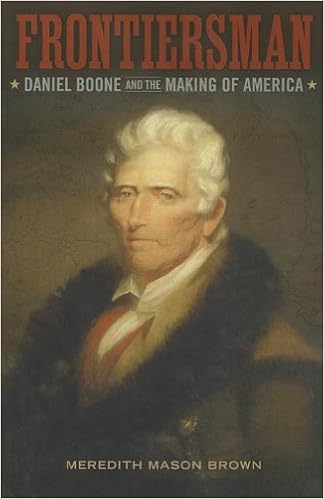
Frontiersman: Daniel Boone and the Making of America by Merideth Brown (2008)

In preparation for my upcoming Flintlock making workshop I decided to get into the proper frame of mind.
I went with a more modern publication because the older stuff is reported to have a lot of myth sprinkled in. Lots of good illustrations of rel event documents.
This version is a little plodding but an historical outline can be that way.
With this however one is able to begin to piece together the American psyche at it's core or at least at it's beginning.
Maybe our fascination with winning the lottery, the robber barrons, discovery, individual dreams, even "finders - keepers" etc. comes from the earliest settlers / immigrants.
These people were keenly aware of the very simple concept of buying land cheap, getting people to move into an area and selling bits off at a time.
This included George Washington and any one with money; all you had to do is "settle" it. by means of buying it or taking from the Indians.
Not that complicated but not that easy. Boone was a skilled outdoors man and with fearless determination went into the wild. He was not successful in becoming rich during this part of the American land grab but everywhere he went people followed.
The American Myth:
America has had a never ending search for a Mythological beginning the earliest version seems to have begun with J F Cooper's fictional writings about a Boone like character named Hawkeye and his American made Rifle, the later version that sticks is O Wister's The Virginian.
Not sure who The Virginian was modeled after but Natty Bumpo was very Boone like.
Both of these fictional heroes take on the self reliant noble individual that is the ideal the hard working every man of America.
Saturday, April 23, 2016
The Scottish Chiefs by Jane Porter (1810)
An outstanding but tragic story; long fallen from favor The Chiefs is a gushing romance. With its many pages of truly over the top praises of Wallace's saint like attributes it can be a real eye roll.
The action scenes however are as compelling as any and completely make up for some of the more tedious parts.
A fictional history about the 1st Scottish wars for independence, the Scots seem to be in a never ending war with whomever decides they need to be concurred.
The Scots I think may have been a bit of an easy mark due to their general lack of unity and sophistication. This particular chapter in the History of their struggles starts with the naiveté of thinking that the truthful, honest, and benevolent Edward I (what the hell were they thinking?) had their best interest in mind when they called on him to mediate the succession to the throne after Alexander's carelessness led to his own death in 1286.
Ed had only one thing in mind, expansion, subjugation, and domination.
Having said all this the Scots are a unique and wonderful tribe that without which the world would be a lesser place. Obviously I enjoy the literary contributions of the Scots, and have added Jane Porter to my list. Our present day girls could add her to their list of originals when sighting the great but forgotten leaders of their sex.
This is a rather good condition 1875 printing from Philly.
The action scenes however are as compelling as any and completely make up for some of the more tedious parts.
A fictional history about the 1st Scottish wars for independence, the Scots seem to be in a never ending war with whomever decides they need to be concurred.
The Scots I think may have been a bit of an easy mark due to their general lack of unity and sophistication. This particular chapter in the History of their struggles starts with the naiveté of thinking that the truthful, honest, and benevolent Edward I (what the hell were they thinking?) had their best interest in mind when they called on him to mediate the succession to the throne after Alexander's carelessness led to his own death in 1286.
Ed had only one thing in mind, expansion, subjugation, and domination.
Having said all this the Scots are a unique and wonderful tribe that without which the world would be a lesser place. Obviously I enjoy the literary contributions of the Scots, and have added Jane Porter to my list. Our present day girls could add her to their list of originals when sighting the great but forgotten leaders of their sex.
Subscribe to:
Posts (Atom)